
Skip to content

Free written estimatesLocal crews

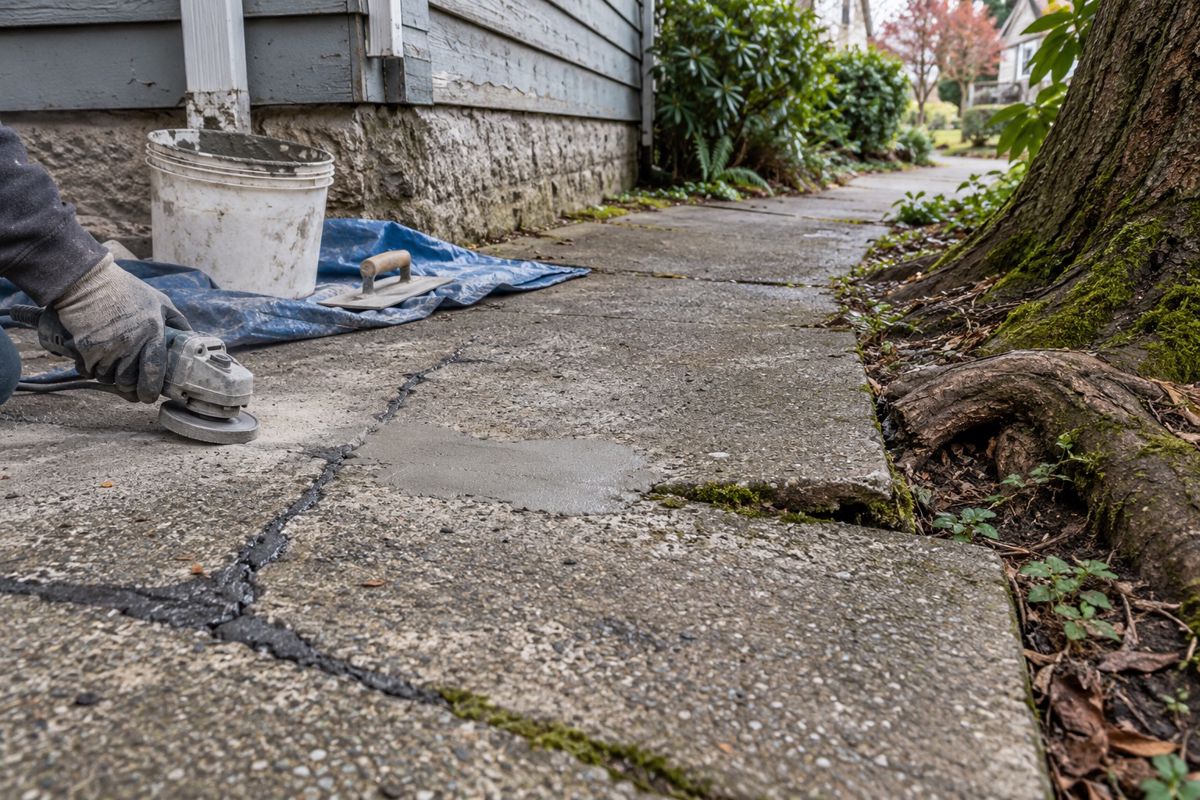
Cracked concrete walkway with a fresh repair patch beside an older Vancouver house

Repair and resurfacing in Vancouver, BC

Concrete repair in Vancouver for cracks, flaking and sunken slabs

We look at why the slab failed first, then quote the repair that fits, whether that is patching, levelling, resurfacing or replacement.

  • Cause checked before the repair is chosen
  • Honest advice when replacement makes more sense
  • Written scope and price before work starts

Step 1 of 3

What do you need?

What can be repaired in concrete, and what needs replacing?

Many concrete problems can be fixed without tearing the slab out. Others cannot, and an honest contractor tells you which is which. The most common repair jobs include:

  • cracks that have opened or are letting water in
  • flaking, peeling or pitted surfaces
  • sunken or tilted slabs and uneven joints that cause trips
  • worn, stained or dull surfaces that need a fresh finish
  • broken corners and edges on steps and slabs

As a rough guide, repair makes sense when the slab is mostly sound and the damage is limited. Replacement makes more sense when the slab is crumbling throughout, many sections have sunk, or water keeps getting under it because of poor drainage. Fixing the surface without fixing the cause usually means the problem comes back.

A site visit lets us tap the surface, look at the cracks, check the slope and see where the water goes. Then we can explain the options. If replacement is the right answer, the work follows the same steps as a new driveway or a new path.

Why does concrete crack, flake or sink in Vancouver?

Concrete rarely fails for just one reason. In and around Vancouver, these causes show up often.

  • Water. Heavy rain soaks into cracks and the soil below. The base softens, and slabs settle or move.
  • Freeze and thaw. Cold snaps are not frequent, but wet concrete that freezes can flake on the surface, mostly on older slabs and those without air entrainment.
  • Tree roots. Roots lift and crack slabs, especially near mature street trees and large cedars.
  • Poor base or fill. Slabs poured on loose fill or without gravel can sink over time.
  • Drainage problems. Downspouts or runoff aimed at a slab can wash out the soil underneath.
  • Age and wear. Slabs poured decades ago in older neighbourhoods may have reached the end of their life.

Fixing the cause matters. Redirecting a downspout or trimming a root can protect a repair. If the problem is a driveway or patio that fails again and again, replacement with a proper base may cost less in the long run than repeated patching.

What are the repair and resurfacing options?

There is a range of repairs, from small to large. Which one fits depends on the damage.

Crack filling and sealing

Narrow cracks are cleaned and filled with a flexible sealant to keep water out. This does not make a crack disappear, but it slows further damage.

Patching

Broken corners, spalled areas and pits are cut out and filled with a repair mortar that bonds to the old concrete.

Grinding

A slightly raised edge can sometimes be ground flat to remove a trip hazard.

Lifting and levelling

Sunken slabs can sometimes be raised by pumping material through small holes under the slab. It is a lighter job than replacement, though it only works when the slab itself is in good shape.

Resurfacing

A thin overlay can renew a worn, stained or flaking surface and add colour or texture. It needs a sound slab underneath. See our stamped concrete page for decorative finishes.

Repair costs vary more than new work, because the damage is different on every slab. Here is what affects the quote.

  • How much damage there is. A few cracks cost far less than a whole slab with flaking and settlement.
  • The cause. If water or roots are still at work, the cause may need fixing too.
  • The method. Crack sealing, patching, levelling and resurfacing each need different tools and materials.
  • Slab size and access. A large driveway takes more time than a single step.
  • Surface prep. Cleaning, grinding and removing old coatings take labour.
  • Colour and finish. A plain patch costs less than a coloured or textured overlay.
  • Comparison with replacement. When repair costs approach the cost of new concrete, replacement is often the better value.

Ask us to quote the repair and, where it makes sense, the replacement too, so you can compare the two.

How long does repair take, and when should you call?

Small repairs such as crack filling and patching can often be done in a day, while resurfacing and levelling take longer because materials need time to cure. Dry weather matters, since many repair products need a clean, dry surface to bond well. In the wet season that may mean waiting for a dry spell.

Call when you see cracks wider than a pencil line, a step or slab edge that has lifted, flaking that is spreading, or water pooling where it never did before. Early repair is nearly always cheaper than waiting. A tilted slab next to a house should be checked soon, because it may be sending water toward the foundation, which is a matter for a slab and footing specialist or an engineer.

Our home page gives an overview of the other jobs we quote. Send the short form with a few photos of the damage and the size of the area, and we will arrange a site visit.

  • Free written estimates
  • Local crews
  • Clear timelines
  • Site cleanup included

Step 1 of 3

What do you need?

Questions about concrete in Vancouver

Can a cracked driveway be repaired instead of replaced?

Sometimes. If the slab is mostly sound and the cracks are narrow and stable, sealing and patching can extend its life. If the cracks are wide, offset or spread across the whole slab, replacement is usually the better choice. A site visit shows which applies.

Can sunken concrete be raised?

Often yes. Sunken slabs can sometimes be lifted by pumping material through small holes beneath them. It works best when the slab is whole and the cause of the settlement has been found. If the soil keeps washing out, the problem can return, so the cause has to be dealt with too.

What is concrete resurfacing?

Resurfacing puts a thin bonded layer over a sound old slab to renew the surface. It can hide stains and surface wear and add colour or texture. It is not a fix for deep cracks, settlement or a failing base, which need other repairs first.

Why is my concrete flaking?

Flaking, called spalling, often follows freeze and thaw when the surface is wet. De-icing salts, poor finishing and older mixes make it worse. Light flaking can often be repaired or resurfaced. If it covers most of the slab, the concrete may be near the end of its life.

Is a trip hazard something I should fix quickly?

Yes. A raised edge or a step in a walkway can cause falls, and it usually gets worse. Grinding a small lip can fix it, and a sunken slab may need lifting. If the path is on public property, contact the City instead of repairing it yourself.

How it works

  1. Step 1

    Tell us about the project

    Size, finish and goals.

  2. Step 2

    Site visit and quote

    We measure and price it in writing.

  3. Step 3

    Form, pour, finish

    Base, forms and finish done in the right order.

Ready when you are

Call now or request a quote online.

(604) 555-0140
Get my free concrete quote