
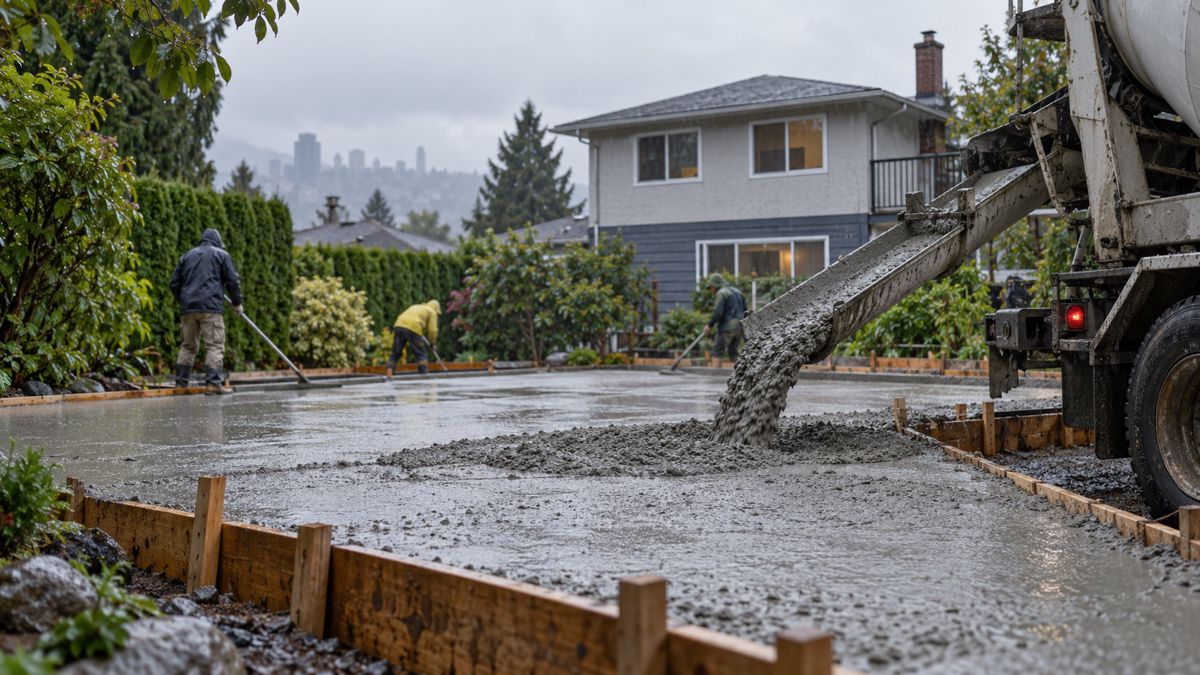
Concrete pouring in Vancouver usually costs somewhere between C$10 and C$35 per square foot, depending on the type of job. A plain slab sits at the low end, a driveway with demolition sits in the middle, and a stamped or coloured patio sits at the high end. These are rough market guides, not quotes from this business. Your own price depends on the site, so treat the numbers below as a starting point for planning.
What is the rough cost per square foot in Vancouver?
Prices in the Vancouver area tend to run higher than in many parts of Canada because of labour costs, tight access and disposal fees. As a rough guide in Canadian dollars (CAD), people commonly see ranges like these for residential work:
- Plain concrete slab or pad: about C$10 to C$20 per sq ft.
- Concrete driveway: about C$12 to C$25 per sq ft, more if an old driveway has to come out.
- Walkway or small path: about C$12 to C$25 per sq ft, since short runs cost more per foot.
- Stamped or coloured patio: about C$18 to C$35 per sq ft.
- Exposed aggregate finish: often priced between plain and stamped work.
In metric terms, one square foot is about 0.093 square metres, so these figures are close to C$108 to C$376 per square metre. Quotes may be in either unit, so check which one you are looking at. Small jobs often cost more per square foot than large ones, because the crew, the truck and the setup are the same.
What drives the price of a concrete pour?
The per-foot figure is only an average. These factors push a job toward the low or the high end.
- Thickness. A 100 mm (4 in) slab uses less concrete than a 150 mm (6 in) slab, which is what heavier use may need.
- Reinforcement. Rebar or mesh adds material and labour.
- Finish. Broom finish is the simplest. Colour, exposed aggregate and stamping take more time and materials.
- Site preparation. Digging, grading, adding gravel and compacting the base can be a big part of the cost.
- Demolition. Breaking up and hauling away old concrete adds labour and dump fees.
- Access. Narrow side yards, steep lots and lane-only access may need a pump truck or hand placement.
- Season and weather. Wet weather can delay a job and add covers and protection.
Two jobs of the same size can be priced very differently because of these details, which is why a site visit matters more than any online calculator.
How much concrete do you need?
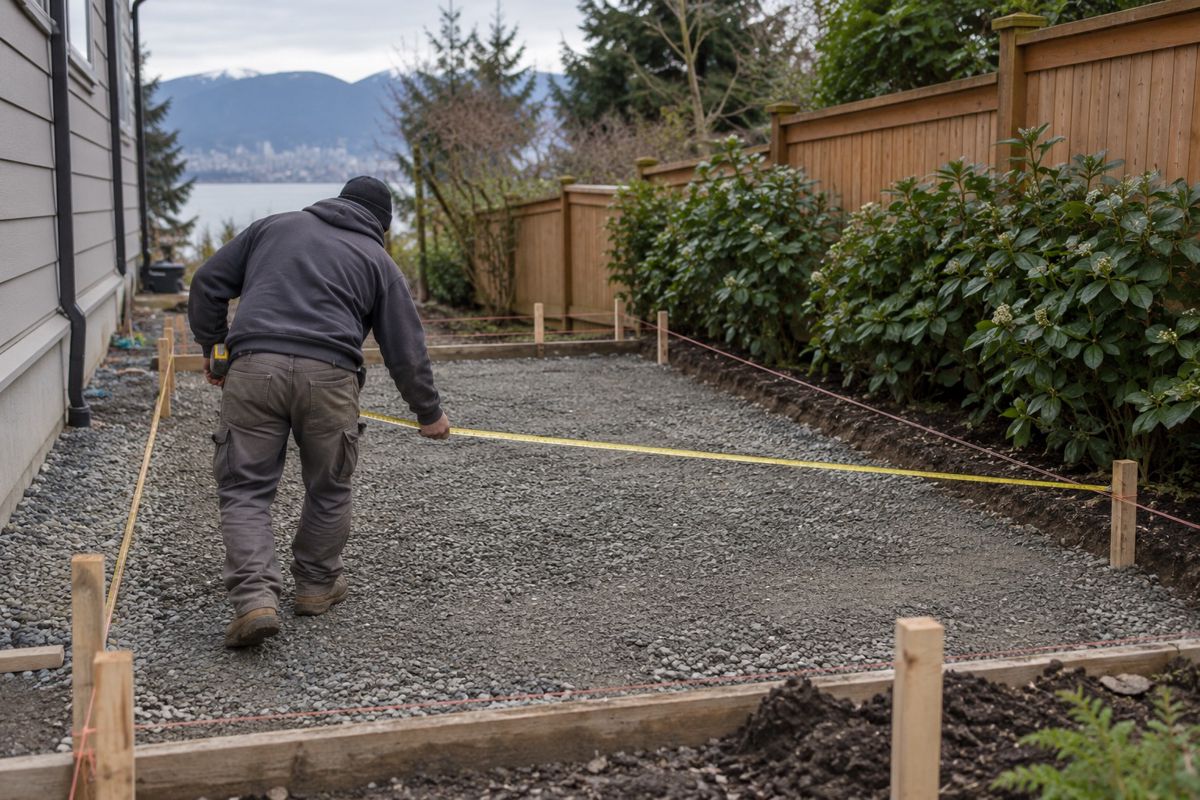
Ready-mix concrete is sold by the cubic metre and delivered by truck. You can estimate the volume yourself with a simple calculation: area times thickness.
For example, a single-car pad about 3 m by 6 m (10 ft by 20 ft) has an area of 18 square metres, or about 200 sq ft. At 100 mm (4 in) thick, that is about 1.8 cubic metres. Most crews add 5 to 10 percent for uneven ground, waste and spillage, so the order might be closer to 2 cubic metres.
Here are a few more quick checks:
- 100 sq ft at 100 mm thick needs roughly 0.95 cubic metres.
- At 125 mm (5 in) thick, add about a quarter more concrete.
- Footings and thickened edges use extra concrete, so they should be added to the estimate.
Suppliers often charge extra for very small loads, so a small walkway can cost more per cubic metre than a large driveway.
Putting it together, a 200 sq ft slab at the rough guide of C$12 to C$25 per sq ft would land between about C$2,400 and C$5,000. That is only an illustration of how the maths works. It is not a quote.
What extra costs show up on Vancouver lots?
Local conditions can add items that a general guide does not show.
- Drainage. Heavy rain means many sites need a good fall, a drain or a gravel base built to carry water away. This adds work but protects the slab.
- Sloped lots. Hillside driveways and front yards may need retaining edges, steps or extra forming.
- Lane and side access. Many Vancouver backyards cannot take a truck, so concrete may be pumped or carried in by wheelbarrow.
- Tree roots. Mature trees may mean cutting roots, which should be done carefully, or changing the layout.
- Old Vancouver Specials and heritage homes. Existing slabs and foundations may be uneven, so more levelling and tie-in work is needed.
- Permits and City work. Work near the street, a driveway crossing or structural slabs may need City of Vancouver approval and inspections. Check the current rules with the City.
- Disposal. Dump fees for concrete and soil can add up on large demolition jobs.
None of these are surprises if they are discussed at the site visit and written into the quote.
Does thickness and reinforcement change the cost?
Yes, and it is also where cheap quotes sometimes cut corners. A thin slab with no steel and a poor base may look the same on day one, but it is more likely to crack and sink. Concrete is sold by volume, so a thicker slab costs more in material, and reinforcement adds both material and labour.
Common guidance for home use is about 100 mm (4 in) for walkways and patios and 100 to 125 mm (4 to 5 in) for driveways, with thicker sections where heavy vehicles or structures need them. Engineered slabs and footings follow the drawings. Do not reduce thickness or skip the base to save money, because the repair costs more than the saving.
Air-entrained concrete, which holds tiny air bubbles, is also commonly used outdoors because it handles wet and occasional freezing better. Ask what mix is being used and why.
How can you compare concrete quotes fairly?
A low total is not always a good deal. To compare two quotes, make sure they cover the same work. Ask each contractor to state:
- the area, thickness and finish
- whether demolition and haul-away are included
- the base material and depth
- reinforcement type and spacing
- joints, sealing and curing
- drainage work and any permit responsibilities
- the payment schedule and what happens if rain delays the pour
Ask for proof of liability insurance and a WorkSafeBC clearance letter, and ask whether the business holds a City of Vancouver business licence. Be careful with large cash deposits and with quotes that arrive without anyone seeing the site.
Which service page fits your job?
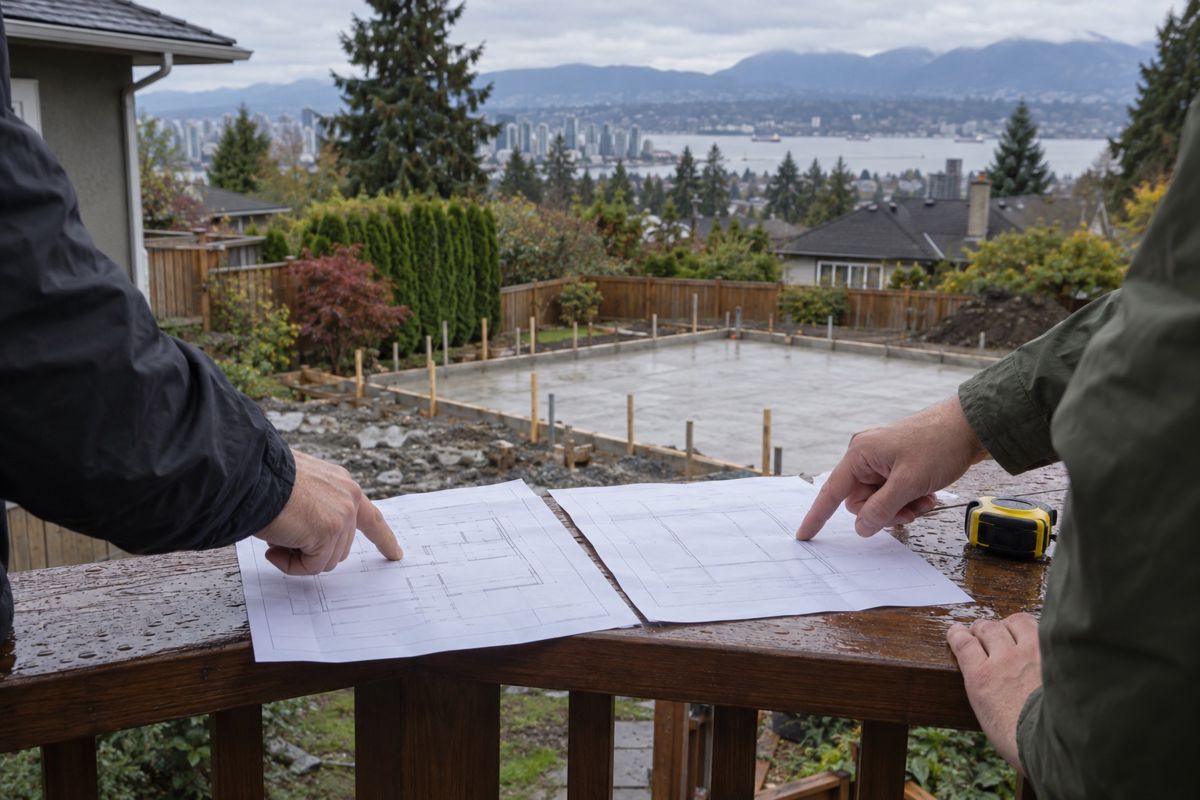
If you are planning a new driveway, our concrete driveway page explains the steps, timing and cost factors in more detail. For a decorative yard surface, see stamped concrete patios. If you have a slab that is cracked or sunken, concrete repair and resurfacing may save you from a full replacement. When you are ready, use the call button or the short form on the site, describe the job and the size, and ask for a written quote.